Best AI Content Creator Tools in 2026: Complete Guide for Marketers and Founders
If you're a founder or marketer trying to maintain a consistent content cadence without a dedicated team, you've likely considered using an AI content creator to bridge the gap. The landscape in 2026 has matured significantly—tools are more capable, workflows are more refined, and the line between AI-assisted and AI-generated content continues to blur. But with dozens of options available, choosing the right artificial intelligence content tools for your specific needs requires clarity on what these systems actually do, where they excel, and where human oversight remains non-negotiable.
This guide breaks down the current state of AI content generation, compares the leading tools across formats, and provides practical guidance for building workflows that actually ship quality content.
What Is an AI Content Creator and How Does It Work in 2026
An AI content creator is software that uses generative AI—primarily large language models (LLMs) and diffusion models—to produce text, images, video, or audio based on prompts and inputs you provide. The underlying technology combines natural language generation with machine learning trained on massive datasets to predict and generate content that matches your intent.
In 2026, these tools have moved beyond simple text completion. Current AI writing assistants can:
- Generate structured long-form content from outlines or brief notes
- Maintain consistent tone across multiple pieces when trained on your existing content
- Produce first drafts that require editing rather than complete rewrites
- Handle multi-format output from a single idea (post, article, script, carousel)
What they cannot reliably do: verify facts, generate truly original insights, understand your specific business context without explicit input, or replace the strategic judgment that makes content resonate with your particular audience.
Think of AI content tools as draft generators that accelerate the blank-page-to-rough-draft phase. The editing, fact-checking, and strategic refinement still require human involvement.
Why Content Creators and Founders Are Adopting AI Tools
The shift toward automated content creation isn't about replacing writers—it's about solving a specific operational problem: founders and small teams can't maintain publishing cadence without bottlenecking on the person who holds the insights.
Three practical drivers behind adoption:
Time compression. A founder who needs 10 hours weekly for content can reduce that to 2-3 hours by using AI for first drafts and focusing human time on editing and validation.
Scaling without hiring. For teams where the founder is the source of ideas and perspective, AI tools let you multiply output without adding headcount. One idea becomes a LinkedIn post, a carousel, a short script, and a blog article.
Cadence sustainability. Content marketing AI helps maintain regular publishing even during busy periods. Instead of going dark for weeks, you can batch-generate drafts from quick voice notes or bullet points.
The cost efficiency matters too. A capable AI writing assistant runs $20-100/month versus $3,000-8,000/month for a dedicated content hire. For early-stage founders, that math is decisive.
Best AI Writing Assistants for Blog Posts and Long-Form Content
For long-form content—blog posts, documentation, guides—several tools stand out in 2026:
Claude (Anthropic) — Strong at nuanced, structured writing. Best for founders who want drafts that require lighter editing. Pricing: ~$20/month for Pro tier with generous limits.
ChatGPT Plus (OpenAI) — Widely adopted, solid general-purpose AI text generator with good speed. Integrates with many third-party tools. ~$20/month.
Jasper — Purpose-built for marketing content with templates for specific formats. Higher price point (~$39-99/month) but includes brand voice training features.
Notion AI — Embedded in the Notion workspace, useful for teams already in that ecosystem. Best for brainstorming and short-form drafts rather than polished long-form. Included with Notion Plus ($10/month) or as add-on.
Copy.ai — Strong for marketing copy, landing pages, and ad variations. Free tier available; paid plans start around $49/month.
For B2B founders creating thought leadership content, the key differentiator isn't raw writing quality—most tools are comparable. It's how well the tool integrates into your capture-to-publish workflow and whether you can train it on your voice.
Top AI Tools for Social Media Content Creation
Social media has specific constraints: character limits, platform conventions, the need for hooks and engagement. AI content generation tools optimized for social include:
Taplio — LinkedIn-focused, includes post generation, carousel creation, and scheduling. ~$49/month. Strong for founders building LinkedIn presence.
Typefully — Twitter/X focused with AI assistance and thread scheduling. Free tier; paid from $12.50/month.
Buffer + AI features — Scheduling platform with integrated AI suggestions. Useful if you're already using Buffer for multi-platform publishing. Free tier; paid from $6/month per channel.
Content OS platforms — Tools that capture ideas (including voice memos) and generate multi-format drafts for validation before publishing. These prioritize supervision and founder voice over pure automation.
The workflow matters more than the tool. For LinkedIn specifically, the winning approach is: capture insight → generate draft → human edit for specificity → validate → schedule. Pure AI output without editing rarely builds trust with B2B audiences.
AI Image and Video Generators for Visual Content
Visual AI content creator tools have advanced rapidly:
Midjourney — Still the quality leader for images in 2026. Subscription-based (~$10-60/month). Best for social graphics, cover images, and conceptual visuals.
DALL-E 3 (via ChatGPT) — Integrated into ChatGPT, convenient for quick image generation alongside text. Quality slightly below Midjourney but improving.
Runway — Video generation and editing. Strong for short-form video content, product demos, and social clips. Pricing varies by usage.
Canva AI — Image generation and editing embedded in Canva's design platform. Best for teams already using Canva. Included in Pro plans (~$15/month).
HeyGen / Synthesia — AI avatar video for talking-head content. Useful for internal communications or educational content where you don't need the founder on camera every time. ~$30-100/month.
Practical guidance: Use AI-generated images for abstract concepts, cover images, and social graphics. Be cautious with AI video for external content—audiences often detect AI avatars, which can undermine credibility.
Free vs Paid AI Content Creator Tools: What You Actually Get
Free tiers exist for most AI content generation tools, but the limitations matter:
| Feature | Free Tiers | Paid Plans |
|---|---|---|
| Output volume | 500-2,000 words/month typical | 50,000-unlimited words/month |
| Model quality | Often older/slower models | Latest models, faster response |
| Brand voice training | Usually absent | Often included in higher tiers |
| Integrations | Limited or none | API access, workflow integrations |
| Image generation | Low resolution, watermarks | Full resolution, commercial use |
| Support | Community/docs only | Priority support |
Realistic assessment: Free tiers are useful for testing and occasional use. If you're publishing 2+ pieces weekly, you'll hit limits quickly. The upgrade decision usually comes down to: is your time worth more than $20-50/month? For most founders, yes.
How to Choose the Right AI Content Tool for Your Use Case
Selection criteria that actually matter:
1. Content type priority. If 80% of your output is LinkedIn posts, choose a tool optimized for that. Don't pay for video generation you won't use.
2. Workflow integration. Where do your ideas live? If you capture in Notion, Notion AI makes sense. If you capture via voice memos, you need a tool that handles audio input.
3. Voice training capability. For founder-led content, the tool must learn from your existing content. Generic AI output damages credibility in B2B.
4. Validation workflow. Does the tool support review before publishing? Pure automation without supervision is risky for content "under your name."
5. Budget reality. Stack costs realistically: AI writing ($20-50) + AI images ($10-30) + scheduling ($10-50) = $40-130/month. Compare against your time cost.
For B2B founders specifically: prioritize tools that support the capture → draft → validate → publish flow, keeping you in control of what ships.
Building an AI-Assisted Content Workflow: Practical Examples
Here's what an AI-powered writing workflow looks like in practice:
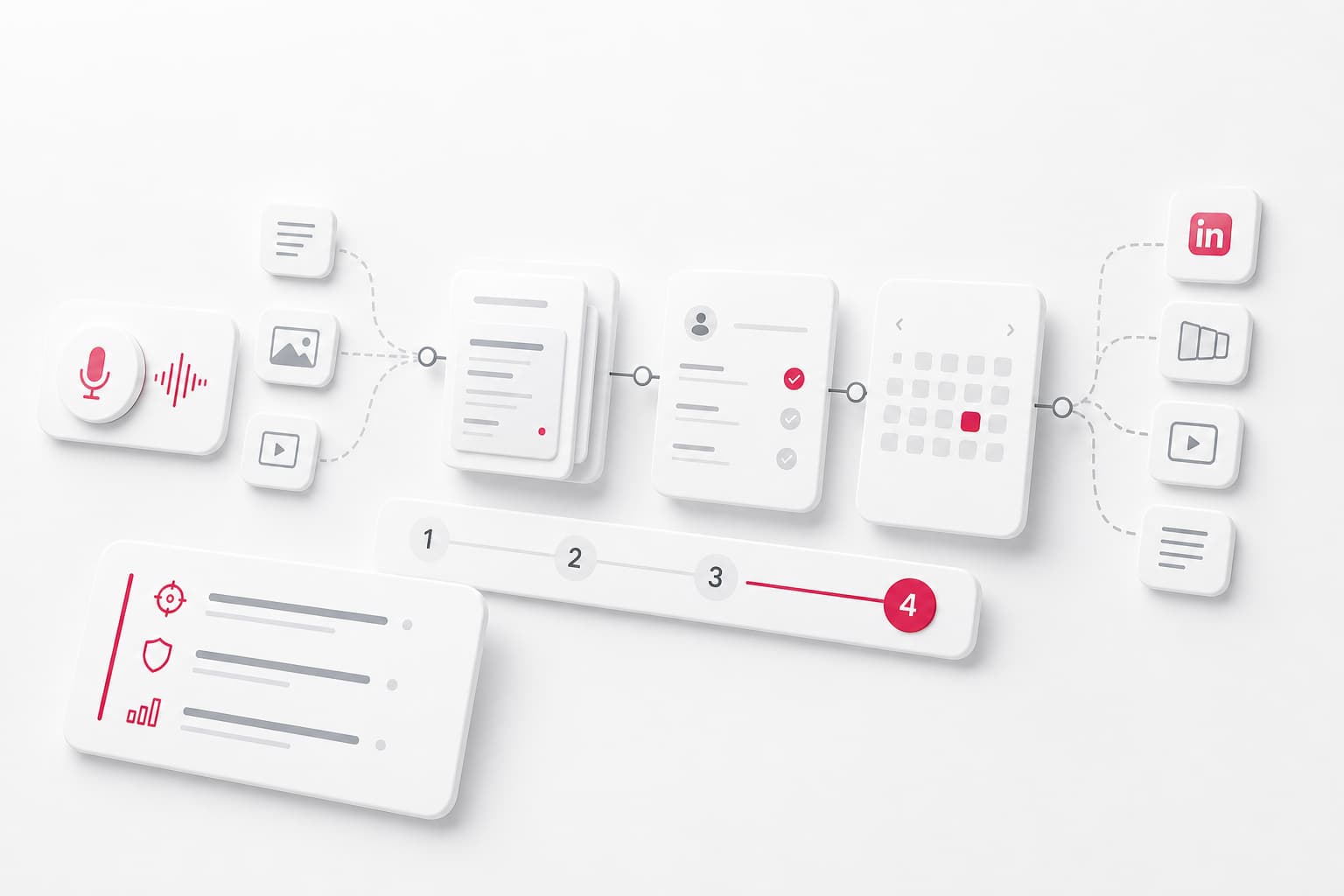
Example 1: Voice-to-Content Pipeline
- Capture a 3-minute voice memo after a sales call (insight about a common objection)
- AI transcribes and extracts the core insight
- AI generates drafts: LinkedIn post, carousel outline, blog introduction
- You spend 15 minutes editing for specificity and accuracy
- Validate and queue for scheduled publishing
Result: One insight becomes a week of content with ~20 minutes of founder time.
Example 2: Blog Article Production
- Create a brief outline with 5-7 key points
- AI generates a 1,500-word first draft
- Human review for accuracy, adding specific examples from your experience
- AI-assisted editing pass for clarity and flow
- Final human review and publish
Result: Article that would take 4-6 hours drops to 1.5-2 hours.
Example 3: Content Repurposing
- Start with an existing long-form piece (webinar transcript, podcast, article)
- AI extracts 5-8 standalone insights
- AI generates social posts from each insight
- Human edit for platform-specific format and tone
- Schedule across platforms
Result: One substantial piece becomes 2-3 weeks of social content.
The pattern: AI handles volume and first drafts. Humans handle judgment, accuracy, and specificity.
Limitations of AI Content Creators and Best Practices for Human Oversight
Current AI content generation limitations you must account for:
Factual accuracy. AI will confidently state incorrect information. Every claim needs verification, especially for statistics, quotes, or recent events.
Originality deficit. Machine learning content tends toward the generic mean of its training data. Real insights come from your specific experience—AI can articulate them but can't generate them.
Voice drift. Without careful prompting and training, AI output defaults to a generic "helpful assistant" tone that doesn't match your brand voice.
Context blindness. AI doesn't know your strategy, your audience's objections, or what you said last week. Consistency requires human oversight.
Hallucination risk. Natural language generation can invent plausible-sounding details. Never publish without fact-checking claims.
Best practices for human oversight:
- Always review before publishing—content "under your name" reflects on you
- Add specific details from your actual experience that AI can't know
- Verify any factual claims, especially numbers and quotes
- Read aloud to catch unnatural phrasing
- Compare against your existing content to ensure voice consistency
- Build a feedback loop: note what works, train the AI accordingly
Frequently Asked Questions
Can AI content creators fully replace human writers in 2026?
Not for quality content. AI excels at generating drafts, brainstorming ideas, and scaling output volume. But human oversight remains essential for accuracy, brand voice, strategic alignment, and the specific insights that make content valuable. The best results come from AI-assisted workflows where humans validate and refine everything before publication.
What types of content can AI tools generate?
Current AI tools handle: blog posts and articles, social media updates (LinkedIn, Twitter/X, Instagram captions), email sequences, landing page copy, ad variations, image graphics, short-form video clips, podcast show notes, and marketing copy. Quality varies by format—text generation is most mature, followed by images, with video still developing.
How much do AI content creation tools cost?
Pricing ranges from free tiers (limited output, older models) to enterprise plans ($500+/month). Most founders and small teams spend $50-150/month total across tools. Typical breakdown: AI writing ($20-50/month), image generation ($10-30/month), scheduling/workflow ($10-50/month). Most tools offer usable free versions for testing.
Are AI-generated articles good for SEO?
AI content can rank well when properly edited for accuracy, depth, and user value. Pure unedited AI output typically lacks the specificity and originality that search engines reward. The winning approach: use AI for structure and first drafts, then add genuine insights, verify facts, and optimize for your target keywords with human judgment.
How do I maintain my brand voice when using AI content tools?
Three essential practices: (1) Feed the AI samples of your existing content to train on your voice, (2) Create a clear style guide specifying tone, vocabulary, and what to avoid, (3) Implement a human review step before anything publishes. Some tools offer explicit brand voice training features—prioritize these if voice consistency matters for your audience.
Moving Forward with AI Content Tools
The practical question isn't whether to use AI content tools—it's how to integrate them into a workflow that maintains quality while solving the founder time bottleneck.
Start with your biggest constraint. If you struggle with the blank page, use AI for first drafts. If you have ideas but no time to develop them, use voice capture with AI expansion. If you have long-form content but can't repurpose it, use AI for format transformation.
The tools work best when they accelerate what you're already trying to do, with validation checkpoints that keep you in control of what ships under your name.
If you're looking to build a content pipeline that captures your ideas and generates validated drafts without requiring a content team, explore tools designed specifically for founder-led content workflows—systems that prioritize supervision over pure automation.