AI LinkedIn Ghostwriter: How to Build Your Personal Brand Without Writing a Single Post in 2026
You know you should post on LinkedIn. Your prospects are there. Your competitors are there. The deals you want start with conversations that begin because someone saw your content.
But here's the reality: you're running a company. You're in sales calls, product decisions, and customer conversations. Writing three thoughtful posts a week feels impossible.
This is exactly why the concept of a ghostwriter LinkedIn IA has exploded among B2B founders in 2026. AI-powered ghostwriting lets you maintain a consistent presence without spending hours staring at a blank screen.
Let's break down how it actually works, what your options are, and how to use these tools without sounding like a robot.
What Is an AI LinkedIn Ghostwriter and How Does It Work?
An AI LinkedIn ghostwriter is a system that transforms your raw ideas—voice notes, bullet points, rough drafts—into polished, publish-ready LinkedIn content.
Unlike generic AI writing tools that produce bland, interchangeable posts, a dedicated AI writing assistant for LinkedIn is trained to:
- Learn your voice patterns and vocabulary
- Structure content for LinkedIn's algorithm and reading behavior
- Turn fragmented thoughts into coherent narratives
- Maintain consistency across dozens of posts
The technology behind these tools combines large language models with voice training systems. You feed the AI examples of your writing, record voice memos about your experiences, and the system learns to produce content that sounds like you—not like everyone else.
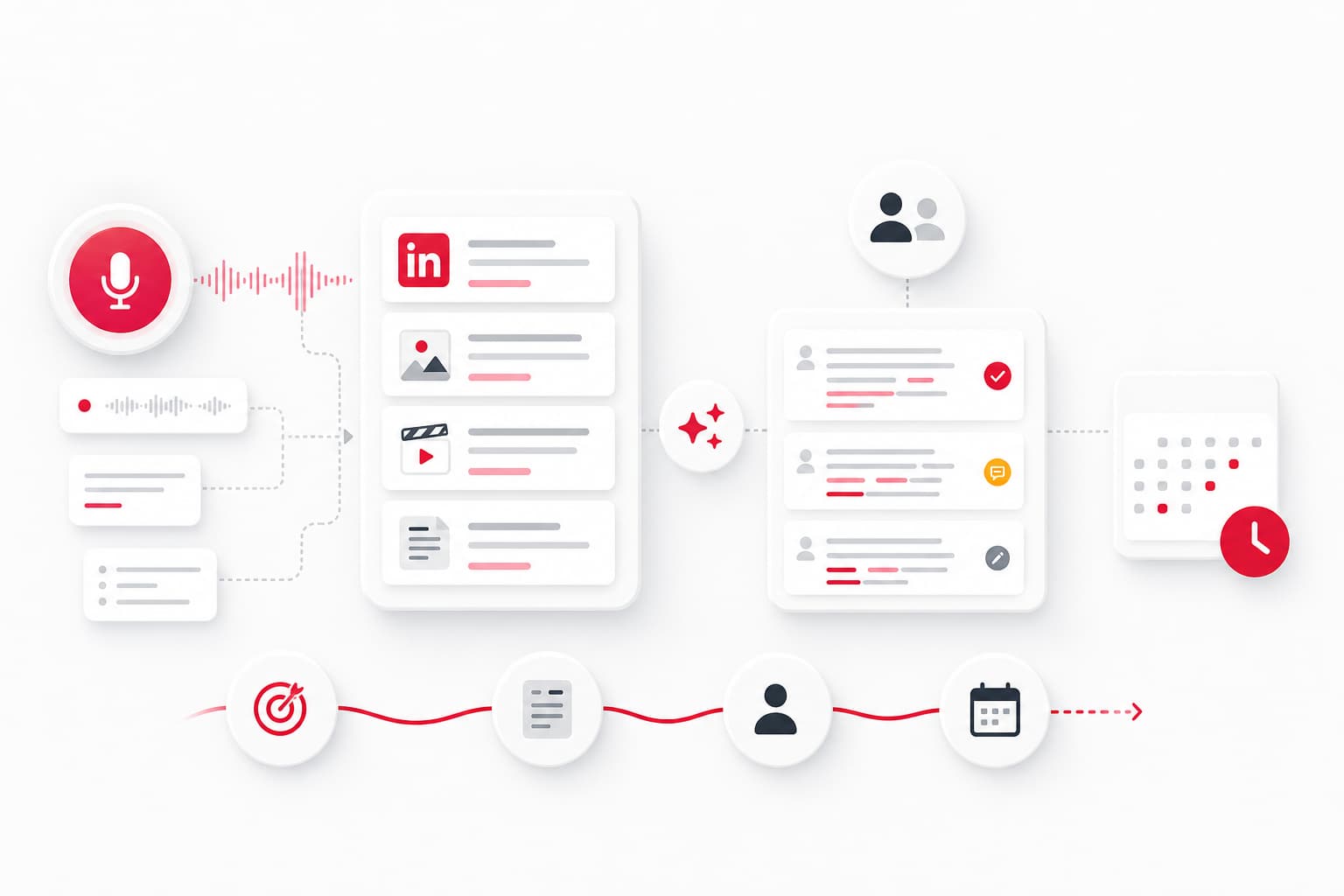
The workflow typically looks like this:
- Capture: You record a 3-minute voice note about a client conversation, a product decision, or a lesson learned
- Generation: The AI transforms that raw input into one or more draft posts
- Validation: You review, tweak, and approve before anything goes live
- Publication: Approved content enters a scheduling queue
The key distinction from fully autonomous AI posting: you stay in control. The AI handles the heavy lifting of structure and polish, but your judgment determines what actually gets published.
Why B2B Founders and Professionals Are Turning to AI Ghostwriting in 2026
The math is simple. Maintaining a strong LinkedIn presence requires:
- 3-5 posts per week for meaningful visibility
- 30-60 minutes per post (ideation, writing, editing)
- That's 2-5 hours weekly, minimum
For a founder juggling product, sales, and operations, those hours don't exist.
But the cost of not posting is real. Your competitors who do show up consistently are:
- Building trust before the first sales call
- Attracting inbound leads who already believe in their expertise
- Creating content that sales teams can reference in conversations
- Staying top-of-mind with their network
Personal branding automation isn't about vanity metrics. For B2B founders, it's about shortening sales cycles. When a prospect has seen six months of your thought leadership posts before you ever speak, the conversation starts differently.
The shift in 2026 is clear: founders who treat LinkedIn content as a business system—with processes, workflows, and tools—outperform those who treat it as something to do "when they have time."
AI Ghostwriting Tools vs Human Ghostwriter Services: A Direct Comparison
Before diving into specific tools, let's address the fundamental question: should you use AI ghostwriting for LinkedIn or hire a human ghostwriter?
Here's how they compare as of mid-2026:
| Factor | AI Ghostwriting Tools | Human Ghostwriter |
|---|---|---|
| Monthly cost | $29-$200 | $500-$10,000+ |
| Voice accuracy | Good (with training) | Excellent (with time) |
| Turnaround | Minutes | Days |
| Scalability | Unlimited posts | Limited by hours |
| Your input required | Voice notes, validation | Interviews, feedback |
| Learning curve | 2-4 weeks | 1-3 months |
| Control | Full (you approve everything) | Partial (trust required) |
When AI tools make sense:
- You're cost-conscious but need consistent output
- You have clear ideas but struggle with writing structure
- You want to maintain direct control over every post
- You're comfortable with technology and process setup
When human ghostwriters make sense:
- Budget allows for premium service ($2,000+/month for quality)
- You need strategic content direction, not just execution
- Your industry requires deep specialized knowledge
- You prefer hands-off delegation over workflow management
Many founders in 2026 use a hybrid approach: AI tools for regular posts, human support for pillar content like long-form articles or keynote-related pieces.
Top AI LinkedIn Ghostwriter Tools and Platforms in 2026
The LinkedIn post generator AI landscape has matured significantly. Here are the categories and representative tools worth evaluating:
Voice-First Content Systems
These platforms prioritize capturing your ideas through voice recordings, then transforming them into content.
Key features to look for:
- Voice-to-text transcription with context understanding
- Multi-format output (posts, carousels, articles) from single inputs
- Scheduling and queue management
- Voice training that improves over time
Pricing typically ranges from $49-$150/month for individual plans.
AI Writing Assistants with LinkedIn Focus
General AI writing tools have added LinkedIn-specific features:
- Post templates optimized for engagement patterns
- Hook generators based on proven formats
- Hashtag and timing recommendations
- A/B testing capabilities
These usually cost $20-$80/month but require more manual structuring.
Full-Service AI Content Platforms
These combine generation with strategy:
- Content calendars and theme planning
- Performance analytics and optimization
- Competitor content analysis
- Engagement pattern recommendations
Expect $100-$300/month for comprehensive platforms.
Evaluation Criteria
When assessing any AI-powered LinkedIn ghostwriter, prioritize:
- Voice training depth: Can it learn your specific patterns, or just apply generic templates?
- Input flexibility: Does it work with how you naturally capture ideas?
- Output control: How much can you customize before publishing?
- Integration: Does it connect with your scheduling and analytics tools?
- Learning loop: Does the system improve based on what performs well?
How to Maintain Your Authentic Voice When Using AI Assistance
The biggest fear founders have about LinkedIn content creation with AI: sounding generic, losing the edge that makes their perspective valuable.
This fear is valid. Most AI-generated content is instantly recognizable—and not in a good way.
Here's how to use AI while preserving authenticity:
Feed the AI Your Best Material
The quality of AI output depends entirely on input quality. Provide:
- Your top 20-30 previous posts or articles
- Voice recordings where you explain concepts naturally
- Email responses where your personality shows
- Presentation transcripts or podcast appearances
The more genuine source material, the better the AI learns your patterns.
Start With Specific Experiences
Generic inputs produce generic outputs. Instead of saying "write about customer retention," say:
"Last week a customer told me they almost churned because of X. We fixed it by doing Y. The lesson was Z."
Concrete details force the AI to work with your specific story, not recycle platitudes.
Build a Validation Workflow
Never publish AI output directly. Create a review checklist:
- Does this sound like something I would actually say?
- Is there a specific insight or experience here, not just general advice?
- Would I be comfortable if a prospect asked me about this in a meeting?
- Does this reflect my actual position, or a watered-down version?
A LinkedIn engagement strategy built on AI-assisted content still requires your judgment as the final filter.
Edit Ruthlessly
AI drafts are starting points, not finished products. Common fixes:
- Remove corporate-speak the AI defaults to
- Add specific numbers, names, and details
- Cut paragraphs that state the obvious
- Inject your actual opinions where the AI hedged
The goal is content optimization LinkedIn audiences respond to: specific, opinionated, grounded in real experience.
Setting Up Your AI Ghostwriting Workflow: From Voice Notes to Published Posts
Here's a practical system for LinkedIn marketing automation that takes 30 minutes weekly instead of 5+ hours:
Monday: Capture (10 minutes)
During your commute or between meetings, record 3-4 voice notes about:
- A conversation from last week that surprised you
- A decision you made and why
- Something you learned from a customer or competitor
- A question someone asked that others probably have too
Each note should be 2-3 minutes. Don't script—just talk naturally.
Tuesday: Generate and Review (15 minutes)
Feed your voice notes to your AI tool. Review the drafts it produces:
- Pick 3-4 that have potential
- Make quick notes on what to fix
- Discard ones that feel forced
Wednesday: Edit and Schedule (15 minutes)
Polish your selected drafts:
- Add specific details the AI couldn't know
- Remove anything that sounds generic
- Adjust the opening hook if it's weak
- Schedule across the week with appropriate timing
Throughout the Week: Engage (10 minutes daily)
No AI tool can replace your engagement. Spend time:
- Responding to comments on your posts
- Commenting thoughtfully on others' content
- Starting conversations in DMs when relevant
This workflow turns scattered ideas into a consistent content pipeline—the kind that builds professional networking content assets over time.
How to Choose the Right AI LinkedIn Ghostwriter for Your Goals
Selecting a ghostwriter LinkedIn IA tool depends on your specific situation:
If You're Just Starting on LinkedIn
Prioritize tools with:
- Strong templates and guidance
- Lower price points while you test commitment
- Educational content about what works
You need structure more than sophistication at this stage.
If You Post Occasionally but Want Consistency
Look for:
- Voice training capabilities
- Queue management and scheduling
- Analytics to understand what resonates
The bottleneck is usually process, not ideas.
If You're Already Active but Want to Scale
Focus on:
- Multi-format output (turn one idea into post, carousel, article)
- Integration with your existing tools
- Team collaboration features if others help with approval
Efficiency gains compound when you're already producing regularly.
If You Need Premium Quality
Consider:
- Platforms with human review layers
- Custom voice training with dedicated support
- Hybrid models combining AI generation with human editing
Some founders find that AI handles 80% of posts, while important pieces get human polish.
Questions to Ask During Evaluation
- How does the tool learn my voice specifically?
- What does the input-to-output workflow look like?
- How much control do I have before publication?
- What happens to content that performs well—does the system learn?
- Can I export my content and data if I switch tools?
Frequently Asked Questions
Is using an AI ghostwriter for LinkedIn considered ethical?
Yes, and it's no different ethically than traditional ghostwriting—which executives, politicians, and thought leaders have used for decades. The ideas come from you. The experiences are yours. The AI assists with structure and polish, similar to how an editor improves a manuscript.
The ethical line is deception: claiming expertise you don't have, fabricating experiences, or publishing without reviewing what goes out. As long as the content represents your genuine thinking, the writing assistance is simply a tool.
How much does an AI LinkedIn ghostwriter cost compared to a human ghostwriter?
As of mid-2026, AI tools typically range from $29-$200/month depending on features and output volume. Human ghostwriters for LinkedIn content generally charge $500-$10,000+ monthly, with quality varying significantly at each price point.
For most B2B founders, AI tools offer 90% of the value at 10% of the cost—making consistent posting financially viable.
Can AI ghostwriters really capture my unique voice and expertise?
They can get close, but it requires effort. The key factors:
- Feeding the AI substantial examples of your existing writing and speaking
- Providing specific, detailed inputs rather than generic prompts
- Editing outputs to remove AI-isms and add your actual phrasing
- Using the tool consistently so it learns your patterns over time
Expect 80-90% voice accuracy with proper training, then human editing handles the rest.
How many LinkedIn posts can I create with an AI ghostwriter?
Most tools don't limit post volume—you can generate dozens daily if you wanted. The practical limit is quality control. A reasonable sustainable pace:
- 4-5 posts per week from 3-4 voice note inputs
- 30-45 minutes total weekly time investment
- 15-20 posts monthly after validation
Consistency beats volume. Five solid posts weekly outperforms twenty mediocre ones.
What should I avoid when using AI to write my LinkedIn content?
Critical mistakes to avoid:
- Publishing without review: Always validate before posting
- Generic prompts: "Write about leadership" produces garbage; specific experiences produce value
- Over-automation: Engagement still requires your presence
- Abandoning your voice: If something sounds off, it is—edit or discard
- Fabricating experiences: AI can help you articulate what happened, not invent what didn't
The goal is AI-assisted authenticity, not AI-generated content posing as human.
Building your presence on LinkedIn doesn't require becoming a full-time content creator. With the right AI ghostwriting system, you can maintain visibility, build trust with your market, and let your real expertise do the selling—without the hours of writing.
The founders winning on LinkedIn in 2026 aren't the best writers. They're the ones who built a system that lets them show up consistently while staying focused on running their business.
Ready to see what an AI-assisted content workflow looks like in practice? Start with one week: capture a few voice notes about real experiences, run them through a tool, and see what comes out. The difference between posting occasionally and posting consistently might be smaller than you think.